
Don Kardong’s 1988 Le Grizz Article in Runner’s World Magazine
LE GRIZZ
The race begins at birth.
And ends somewhere over the finish line.
Like most stories, this one could begin almost anywhere. At conception. At birth. On the day I first began running. At the moment I discovered that, more than almost anything, I loved running through the woods, feeling an integral, primitive, living part of the planet.
Perhaps the best point to begin, though, is at the moment I paid my $30 entry fee. Thirty dollars, after all, is not just three sawbucks. It signifies, rather, at commitment-in this case a commitment to run 50 miles. And so I hovered, a detached observer far above my check- book, watching myself sign on the dotted line. Apparently I was actually going to do this thing.
For five years I had heard of Le Grizz, a 50-mile race in Montana. For love of this event, friends from Spokane, Washington, had driven long distances, camped in freezing weather, eluded raven- ous bears and run, walked and ultimately dragged themselves to a distant finish. line. Then, the trek completed, they had soaked in hot tubs and consumed beer and pizza until the pain subsided, leaving only the memories of an extraordinary adven- ture to relate to the folks back home.. Most, it seemed, remained delirious for days, professing to having enjoyed them selves.
I found this interesting. I had always been fascinated with ultramarathons (or “ultras”), had once even considered running 70 miles from the English town where I lived to the ancient monument of Stone- henge. The point? Some sort of neo-Dru- idic experience, I suppose, an athletic-religious-cosmic adventure. My friends thought I was nuts and talked me out of it.
Later I ran my first marathon, learning that it is not easy to run mile after mile after mile after mile. If strange things can happen in a race of only 26 miles, what might lay in the void beyond?
“Fifty miles is a whole new world compared to the marathon,” noted the Le Grizz entry form. “It is a world of new knowledge of oneself, of self-actualization and of brotherhood.”
Obviously, someone penned this line in the delirium of postrace hot-tubbing. Still, the lure remained considerable. I can’t explain why we choose to challenge the extremes of human endurance-climbing Mount Everest, swimming the English Channel or pursuing our own personal fantasy. But here’s what I think: To explore boundaries is the reason for living.
For years, 50 miles sat on a back burner in my mind, simmering. Eventually, I succumbed.
THE NIGHT BEFORE
There are moons and then, I swear, there are moons. On the evening before my first 50-miler, the moon that rose over the mountains behind the Spotted Bear Ranger Station was real moon. Not at fat, lazy, mellow-yellow harvest moon or one of those fuzzy, sociable kind of orbs that smiles over urban landscapes. Rather, this was a piercing, ice-cold, nasty, I’m-the-eye-of-the-universe sort of moon that scattered the stars, scared wild- life, quieted the rocks and glared at our as- sembled group in the campground below. We were, this moon let us know, unlikely to get much sympathy from Mother Nature for what we were about to do.
The temperature was falling like a stone through ice water. Before dawn, it would hit 15°F. October in the Rockies is. a gamble with loaded dice..
“There is always the outside chance, this being Montana,” noted the Le Grizz entry form, “of foul, horrible weather.”
Actually, we were lucky. We didn’t encounter any of the snow, sleet, wind or rain that visited the running of the Le Grizz in 1984. “Runners alternated between feelings of depression and stupidity as the start time approached,” noted the report of that year’s event.
This year it was simply cold. Naked cold. Dazzling-moon cold. You could see clearly a half-mile to the other side of the river. It was cold there, too.
Those who run ultras thrive on extremes. It is not enough, you see, to sim- ply run 50 or 100 miles from point A to point B. We seek the added status that comes from tolerating extremes of temperature, navigating narrow trails and scoring thousands of feet of elevation change in regions where the air is impossibly thin.
To enter Le Grizz, I had been asked to sign the following: “I understand that participating in the Le Grizz 50-Mile Ultramarathon may subject me to injuries and illnesses, including but not limited to hypothermia, frostbite, heat stroke, heat ex- haustion, physical exhaustion, animal attack, falling trees, road failure and vehicle accident.”
Yes, I understand. And I paid my 30 bucks.
I wasn’t alone. Over 40 similarly dis- posed adults had signed up for Le Grizz, up from 25 the year before. Most gath- ered along with family and friend within a 5-foot radius of the campfire at the Spot- ted Bear Campground, trying to carbo- load before the pasta froze.
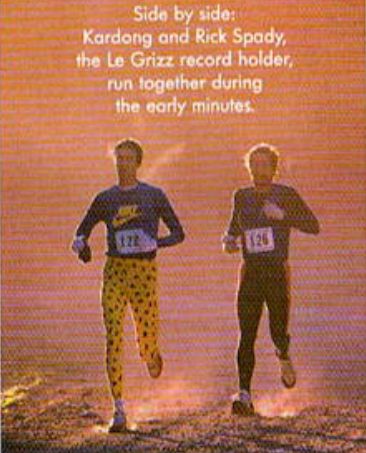
The group included Rick Spady and Jim Pomroy, two Montana runners who between them had won all five previous Le Grizz runs. Spady, the faster of the two, held the Le Grizz record of 5:50:56. He also presided over the firewood, a job that seemed more a reflection of his nature than a specific obligation of the course-record holder.
I have stood around a fair number of campfires in my life, and they all seem blessed with the same purpose: to evoke memories, inspire philosophical ramblings and shake loose a few tall tales. Staring across the fire, one sees friends and strangers lost in thought. Their eyes, re- flecting the glow of sparks from the fire, suggest the kindling of the mind. It is the look of human beings at peace, and also the look that flashes in the eyes of ax mur- derers just before the massacre. It is a look of ambiguous calm, and it appeared on the faces of the ultrarunners that evening.
As the night chill clamped down, most folks headed for the relative warmth of campers, tents and sleeping bags, leav ing only a few seasoned ultrarunners around the fire to tell tales of Leadville, Western States and past Le Grizz struggles. They looked like woodsmen, hunters or perhaps creatures that came sneaking out of the woods in the middle of the night, eyes gleaming.
But they were simply runners of long races, about to begin another. Above them, the eye of the moon blasted its icy light across the wilderness, promising noth- ing but the indifference of Nature to human dreams.
THE START
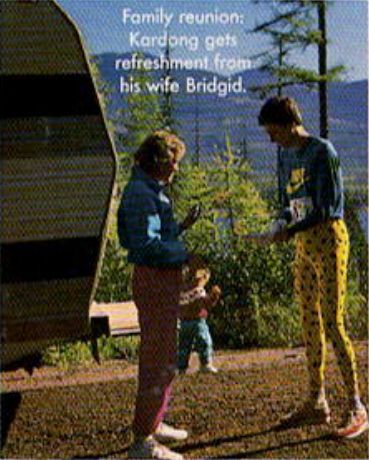
We spent a rough night in the forest. In theory, I had the best accommodations within 50 miles of the starting line. The camper I had rented came complete with kitchen, toilet and sleeping areas for my- self, my wife, Bridgid, and my two daugh- ters, Kaitlin (age 4) and Catherine (age 2). More importantly, it had a heater.
In spite of all this luxury, I thrashed around inside the thing all night, trying to find a spot where I could stretch out and sleep. Sleep deprivation became one more hardship to suffer in the spirit of ultrarunning.
Awakening on the morning of the run, I thought first of food. I ate cereal, cook- ies and whatever else seemed to speak the language of carbohydrates. Though not full, my stomach was engaged, hopefully giving my body a chance at surviving the hours and miles ahead.
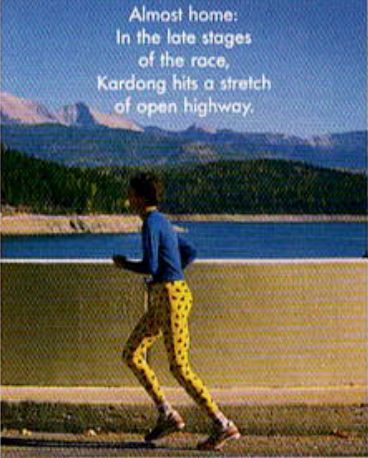
Outside the camper, runners and friends scurried back and forth, puffing clouds of warm breath in the air while searching for food of their own. Many were dressed in custom-made yellow and black tights, the uniform of the day for those of us from Spokane. In the midst of my apprehension, the gaudy tights helped lighten the load. After pulling on a pair, I left the warmth of the camper and went hunting for the race director, Pat Caffrey. He was busy handing out race numbers at one end of the parking area.
Caffrey-the force behind Le Grizz-is the race director, the starter and the man in charge of almost everything. Most importantly, he writes the funny things about Le Grizz on the entry form and other race materials, helping the reader to forget what a gruesome thing a 50-mile run can be.
“Contrary to Yuppie Myth,” wrote Caffrey about the atrocious weather that plagued Le Grizz runners in 1985, “people become wild animals, not environmentalists, when confronted with such a wilderness experience.”
I understood that sentiment. After picking up my number and hustling to the line a few minutes before the eight o’clock starting time, as ready as I was going to be for this thing, I shivered relentlessly as Caffrey began a round of instructions, jokes and (at 15°F!) information on how to buy leftover Le Grizz T-shirts.
“Br. Grrr,” I muttered. Others around me agreed.
“Today’s temperature marks a Le Grizz record,” Caffrey noted, grinning. Our frozen lips couldn’t manage a com- ment. Finally, raising the starting weapon, a 12-gauge shotgun wound with electrician’s tape, the man behind Le Grizz fired a single blast that echoed in the depths of the wilderness.
Numb, we were off.
ZERO TO 10 MILES
The start of most road races is a flurry of arms, legs, elbows and adrenal- ine. The start of Le Grizz seemed more like the opening of Macy’s doors on the day after Thanksgiving. People hurried, but within recognized bounds of propriety. We had time, plenty of time, to complete the task.
It had been so complicated just getting going that morning-finding food, going to the bathroom, making sure cars would start (several needed considerable coaxing), deciding on the right combination of clothing, etc. -that I began to relate to Le Grizz as it should be. Not as a race, but as survival.
I will overcome all this. I will get to the finish.
Other than finishing. I couldn’t decide on an actual race goal. To win? To break 6 hours? I had nothing to base my expecta- tions on, so I had settled on simply run- ning the distance at a comfortable pace and scaling whatever obstacles lay in the road ahead.
After a mile or so, as the numbness in my quads, hands and face began to sub- side, I found myself running with Spady. We discussed ultramarathon training. Spady argued the value of the weekly long run instead of extremely high overall mileage. That system had kept him generally healthy and made him a top contender in races of 50 and 100 miles.
“People shouldn’t worry so much about total mileage,” said the course-record holder. “They’d do a lot better if they’d get out there and just keep going for 6 hours.” Long training runs, the kind that help ultrarunners, require a different perspec-tive on the sport. Years ago I had tried adding 30-mile runs to my marathon train-ing. One evening in 1977, I left home in the dark on an out-and-back course, 15 miles each way. After halt an hour, I was running down a major highway, blinded by headlights and contemplating death. Thirty minutes later, I turned onto a coun-try road, and things grew quiet. Only the breeze in the trees and my padding foot-steps broke the silence. it was more like a dream than any training I was accus-tomed to. Suddenly an owl called “Wh0000000…” from a telephone pole. I’m sorry, but this couldn’t be called training. This was weirdness. It was also my last 30-mile training run for a decade. That’s why I was so worried about Le Grizz. “Things get really weird after 35 miles,” noted Von Klohe, a Spokane friend and ultrarunner who advised me on my Le Grin training. Ultrarunners always say things like that. Then they chuckle. As Spady and I ran along discussing ul-tramarathon training and racing, he re-ported the splits from his past Le Grin runs. They made me nervous. The man was talking 6:10 and 6:20 mile pace—much faster than my own plans. Hearing these splits, I grew anxious for a reason to let him go. That opportunity came at about 7 miles in the form of my support crew, my family. As we headed up a slight in-cline, I spotted them ahead. The Le Grizz weekend represented a watershed for the Kardongs. It was our first night of camping together, at least if an evening in a heated home on wheels can be called camping. Things had gone well so far, but Bridgid and I both re-mained apprehensive about how well our two girls would tolerate 6 hours of riding in a camper while Dad slowly whittled himself to a nub. To get them in the spirit of things, I had put !Caitlin in charge of Dad’s cookies. Seeing my crew alongside the road at 7 miles, I drifted off Spady’s pace, slowed and stopped for aid. Kaitlin handed me a bag of unopened cookies. Bridgid was in the camper, changing Catherine’s diaper. A well-trained support crew is essen-tial to success in ultramarathons. They pro-vide quick access to fluids, food and emo-tional support. As I ripped open the pack-age of cookies, wasting precious time and energy, I realized I had forgotten to give my crew any information about what it was they were supposed to do. Up ahead, Spady was disappearing around a corner.
10 Miles – 1:06:48
I’m not sure exactly how fast I ex-pected to go through the various 10-mile checkpoints, but 1:06:48, including one aid stop and a pee break, seemed about right. I was running steadily, comfortably. Spady was nowhere in sight. The main problem I had faced so far, other than an undertrained support crew, was clouds of dust from support-crew vehi-cles. It had been a dry summer and fall in the Rockies. As vehicles leapfrogged from aid station to aid station, they kicked up billowing clouds of dust, which threat-ened to smother those of us on foot. Spady had speculated earlier that the dusty conditions would last until about 15 miles, when the bulk of the traffic would be behind us and the air would clear. He proved to be only slightly off the mark.
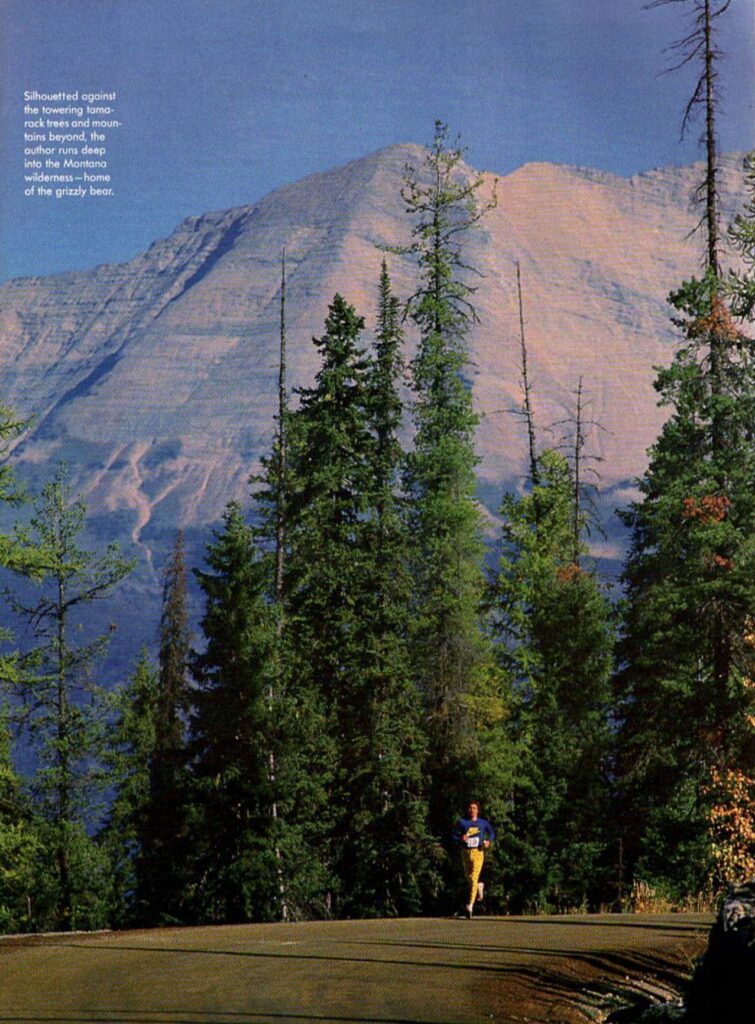
After 10 miles, dust and traffic began to fade, replaced by the full beauty of the coun-tryside through which Le Grin travels. Hungry Horse Reservoir sits on the western side of the continental divide in northwestern Montana, just south of Gla-cier Park. Waters from here flow in convo-luted fashion through Montana, Idaho, Can-ada and Washington, eventually joining the Columbia River. The Le Grizz course follows a road along the southwest side of Hungry Horse Reservoir, affording participants still in control of their faculties an exquisite view across to the Great Bear Wilderness area. The sight itself is worth the drive (though perhaps not a 50-mile run), espe-cially in the fall. In this part of the country. most of the conifers just hunch their shoulders and settle in for the winter with no major transformation. The tamaracks, though, change from green to gold, then drop their needles like any deciduous tree. At the same time, aspens, birches, cotton-woods and alders are busy turning color among the evergreens, splashing their hues across the hills. The aspens, in par-ticular, stand out among the forest giants. brilliant gold, shimmering with the slight-est breeze as if charged with electricity. On this day, too, the moon had joined the scenery, preceding us most of the way. Hanging just above the trees, it had grown less and less harsh, deferring to the ascending sun and the blue sky. The moon had, I imagined, given up glar-ing at us, grumbled and simply accepted the lunacy of human beings. Now that the dust had settled, running through this scenery became distinctly pleasurable. Fifty miles began to seem pos-sible, reasonable, even easy. The view was gorgeous, my legs felt strong and the temperature had warmed to a comfortable level. I was really enjoying myself. The attraction of Le Grizz—the com-bination of scenery and challenge—grew clearer. It was the ability to run without ef-fort through natural splendor. It was the calm of the forest and the joy of self-pro-pulsion. It was the combination of two loves, running and wilderness, that in-duced euphoria. I smiled. This was wonder-ful. And then 1 hit the first big uphill. I wouldn’t call it a monster—just a steady, continuous upgrade of perhaps a half-mile. When it had passed, my eupho-ria had dimmed. I was no longer con-vinced of my ability to travel another 40 miles. My quads had complained on the way up, the first signal of problems lying ahead. With 5 hours of running left. the joy of the forest began to give way to the re-ality of the long road through it. Misery would come later. For now, miles 10 to 20 became a task, a goal within a goal: I must get to the 20-mile mark. Mentally, the secret to running 50 miles lies with the process of putting miles behind you. Ten miles represents one chunk, 20 miles another. It’s a little like fill-ing a garbage bag with aluminum cans. Crush the can, throw it in the bag. Crush another, throw it in the bag. Crush it, bag it, crush it, bag it, crush it, bag it. This is not an elegant process, and at times it seems both endless and meaningless. Eventually, though, the bag is full. At 13 miles, my support crew ap peared again, better prepared this time. I
took a swig of defizzed Pepsi, asked them to meet me in another 3 miles or so and trotted off. They showed up again at 17 miles, where Kaitlin handed me a half- glass of Pepsi and Bridgid announced that I was ahead of Spady.
“I don’t think so.” I answered. “He went ahead at the first stop, and I haven’t passed him.”
“The only guy I’ve seen is that other runner,” she said, referring to someone who was running as part of a relay team. “I’m sure you’re ahead of everyone else.” “I don’t think so.”
I downed the pop and headed off again. Whether I led or not seemed irrele- vant. I needed to relax, conserve en- ergy, try to go with the flow. I hadn’t even reached halfway yet, but already the tightness was growing, from my stomach to my knees.
20 MILES-2:12:58
Twenty miles. A long Sunday morning training run, the kind that drains my legs for at least a couple of days. This time, though, 20 miles marked only the beginning. Thirty more lay ahead.
The split time was encouraging. My pace had held up nicely for the second 10, but was I making a big mistake? Just prior to 20 miles, I had passed the relay runner. Now I began to suspect that Bridgid was right: I was in first place. I couldn’t fig- ure out what had happened to Spady; I be- gan to suspect that he and his crew had played some kind of trick. Perhaps they were leaving me to my own devices, the neophyte ultrarunner, to dig my own grave. Was I running too fast?
Whatever the answers, I consciously slowed myself down and concentrated on getting to 30 miles. Seeing my support crew a short while later, I stopped for more fluid and a molasses cookie, hoping to delay the complete depletion of my dwindling energy reserves.
Every marathoner knows that at a point near 20 miles, the body sends out notices saying, “Enough already.” Running becomes geometrically more difficult, fatigue seems to encompass the body, collapse is imminent and depression sets in. All this happens between one toe-off and the next heel-strike, don’t ask me how. Marathoners call it “hitting the Wall.”
In an effort to avoid the Wall, ultra- marathoners eat on the run. I hoped that the occasional sugary pop and cookie that I consumed would do the trick. However, any attempt to keep the body adequately supplied with energy during a 50-miler can meet with only partial success, and I knew I would soon be running on empty. As
early as 20 miles, I had begun to feel slightly dizzy, moderately disoriented.
An ultramarathon teaches you, as the Zen masters have always insisted, that body and mind are inseparable. The mind does not sit in the skull, happily piloting the body from checkpoint to checkpoint, detached from the organism’s needs. As the body staggers, so does the mind. They are, my friends, connected. If you don’t believe me, try a 50-miler.
Earlier my smoothly running body had made me feel euphoric. Now it was doing a bang-up job of foisting paranoia on the mind. Hungry grizzlies, I grew con- vinced, were watching me run.
The Le Grizz entry form (a.k.a. Pat Caffrey) says the following about midrace wildlife: “The road is lightly traveled in October and goes through wild, mountainous country where grizzly bears still roam.
Other mammals, such as deer, elk, moose, black bear, mountain lion, bobcat and coyote, are common.”
In this year’s final instructions, Caffrey had added the following: “The Montana Department of Fish, Wildlife and Parks has been trapping our grizzly bears from the west side of the reservoir. Six have been removed recently. If this continues, you may be running ‘Le Traps!’
Ultrarunners may be able to laugh at adversity, but when you get right down to it, grizzly bears are not funny. Like sharks, they eat people, and generally without benefit of music.
“Don’t worry,” a ranger at Glacier Park, Montana, once told me. “Grizzlies will only attack if you surprise them, invade their territory or come between them and their cubs.” Three things, I explained to him, that a runner could do with- out realizing it.
A grizzly bear can run up to 30 miles an hour, meaning it could give Ben Johnson a head start and still feast on his carcass at 80 meters. Grizzlies are both unpredictable and quick on their feet.
So there I was, running out in front of the ultraparade, a mostly solitary figure traveling through the wilderness and enjoy- ing the scenery, when it suddenly dawned on me that I heard crackling noises in the bushes.
I’ve spent enough time in the woods to know that even a tiny animal, a chip- munk, for example, can make a lot of noise. A bear, then, ought to sound like a rock slide as it snaps branches, crushes dry leaves and generally bullies its way through the forest. So argued my rational mind, insisting on its ability to make an ob- jective judgment about the crackling of twigs. But, I tell you again, the mind is connected to the body-in this case a body with a fuel tank approaching zero.
“The grizzly could be standing very still, waiting to run me down,” the mind mused. “He’s probably watching me right now. My black-spotted tights, which accent the giraffeness of my legs, are prob- ably invoking some sort of predatory response in the bear at this very moment.”
In a past Le Grizz, one of the Spokane runners had spotted a pile of fresh bear dung in the road. (“Right about this point in the race,” my weakening mind noted.) Another Spokane runner had responded to the crackling and crashing in the underbrush by stopping to throw rocks, a sure sign of glycogen depletion.
I told myself that, should I suddenly encounter a big Yogi, I would respond more appropriately, which meant…well, anyway, I would not throw rocks. Meanwhile, as I continued toward the halfway mark, I tried to relax and imagine that the sounds I was hearing were made by chip- munks, birds and other creatures that used to delight Snow White and not by the sort of animal that can remove a runner’s head with a single swipe of its paw.
MARATHON-2:56:14
In the 1976 Olympics, I ran the mara- thon in 2:11:16. Thus, a time 45 minutes. slower than that should not have pleased me, but it did. Passing the marathon mark in 2:56:14 went much more smoothly than I might have expected..
There is no such thing as an “easy” marathon. Twenty-six miles of easy run- ning still produce sore, tight, fatigued mus- cles and a mind that is tired, scattered and testy. Body and mind have had it. This, the duo agree, would be a good time to stop.
In the very first Le Grizz Ultra- marathon in 1982, runners crossed this point, indicated by “26.2 miles” written in red paint on the road, and immediately ob- served an arrow pointing down the road. with the inscription: THE UNKNOWN. I imagine Pat Caffrey on the evening be- fore the run, grinning devilishly as he wrote this.
Passing the marathon point this time, I had several thoughts. One, I was more than halfway. I had fewer miles to go now than I had already covered. The feeling was similar to what I’ve experienced dur- ing a track workout after completing six out of 10 440-yard repeats. An odd sort of relief blossomed. The garbage bag was more than half full.
Two, I needed to get to 30. In an ul- tra, the satisfaction of reaching a mile- point is short-lived. I wanted to reach the next major milestone immediately.
Three, I needed a potty stop. My stomach had been bothering me for the past 10 miles, and I thought a trip to the bathroom would help. Seeing my support crew ahead, I pulled over and headed into the van for relief.
There’s a Disney cartoon in which Goofy puts on a pair of stretch pants with- out taking off his snow skis. That’s how I felt trying to do my business in the tiny camper toilet. I figured afterward that it had taken at least 3 minutes, most of which involved logistics rather than func- tion. I spent thirty seconds or so convinc- ing Kaitlin and Catherine that they didn’t need to visit me during this activity.
Back on the road I felt much better. Part of me worried that Spady might have caught and passed me during my pro- longed pit stop, but mostly I was con- cerned about monitoring vital signs rather than staying ahead of anyone.
30 MILES-3:25:20
I didn’t take much solace from reaching the 30-mile checkpoint. I could only think: 20 miles left – the length of my Sunday morning long run. Too many miles.
Even the time, 3:25:20, evoked no particular response. More importantly, I had forgotten to share some important information with Bridgid. I had meant to warn her about the drastic personality dete- rioration I expected would soon strike me. When blood sugar drops, the “personality,” a supposedly fixed set of human traits and attributes, proves to be about as per- manent as Mount St. Helens. Ordinarily reasonable, pleasant folks become nasty, whining, hopeless idiots.
This once happened to a friend of mine who, preparing for a marathon, decided to follow the carbohydrate-depletion routine while living in the vicinity of his wife, which proved a big mistake. When she served a meal that didn’t meet his standards, he complained loudly and stomped off to the nearest supermarket. An hour later he returned, looking sheep- ish. “I went to the store, but I didn’t eat anything,” he confessed. “I just walked around.”
“For 45 minutes?” his wife asked in- credulously. It was true. This is fairly typi- cal behavior for a runner whose leg mus- cles have cannibalized all the body’s fuel. It’s best to steer clear of such folks.
My support crew, though, had agreed to stay with me. Even if I became so rude and disagreeable that they would rather hand me over to the grizzlies. We were clearly entering a danger zone of intra- family relationships. When the camper appeared again, I vowed to issue a warning. “Do you need anything?” Bridgid asked sweetly.
“No, but I’m going to start getting nasty pretty soon,” I answered obliquely. Bridgid has watched me slowly deplete be- fore. She knew exactly what I meant.
For the next few miles, the road seemed to climb steadily, rising fairly high above the reservoir. The going got tough, and I labored hard at it. At 33 miles I stopped for fluids, nearly threw up from the ensuing nausea and began walking to regain my equilibrium. Just then Bridgid pulled up beside me in the camper.
“I think you slowed down a bit,” she said innocently, forgetting about my increas- ing depletion. I stared ahead morosely and kept walking. Fortunately, I wasn’t car- rying a weapon.
Suddenly, some kind of large bird, a pheasant perhaps, took flight from the
bushes. It may have been frightened, but I was terrified. My heartbeat soared.
I began to feel the way I had at the Ul- timate Runner, a pentathlon of running events I had entered a year earlier, when I reached the final miles of the marathon. I would travel 1 mile at a time, rewarding myself with a short walking break and a drink at each mile marker. I thought a simi- lar system might help me get through Le Grizz, so I asked my support crew to meet me at every mile marker.
40 MILES-4:38:17
I am entering a world not of sight or sound, but of mind. And the signpost up ahead says: LE GRIZZ-40 MILES.
“Ultramarathons are for the patient and calculating runner,” says the Le Grizz entry form. “You are in charge of your body, your mind, your run.” Well, maybe. At 40 miles, though, it sure as hell didn’t feel like it.
The next 5 miles would prove the hardest of the day. Along with the general beating my legs had taken, my stomach continued to rebel, and my mind drifted from thought to thought like an explorer without a compass. At one moment I’d feel certain that I could win my first 50-miler in less than 6 hours. The next moment I would be struggling against the urge to walk the rest of the way.
For some bizarre reason, a good part of my concern during these miles fo- cused on having Bridgid stop the camper exactly at each mile mark, not 50 or 100 meters down the road. For Bridgid, though, driving along searching for the white mile marks in the road proved to be incompatible with supervising two camper- bound preschoolers. Mile after mile, she missed them. And mile after mile I re- peated my whining request that she drive to the exact mile-marker locations.
“I don’t know why it’s so important to me,” I told her at 43 miles, “but please stop right on the next mark.”
Later on, a Snickers bar in one hand and a beer in the other, this kind of behav- ior seems so foolish. Unfortunately, after 40-plus miles of an ultramarathon, it seems divinely ordained. It was crucial that Bridgid stop where I directed.
Closing in on the 44-mile mark, I grew incensed. Brigid was not there! After all my begging, she still wasn’t on the mark! I cursed. I may have even picked up the pace a bit, anticipating that I’d see the camper around the next turn. She wasn’t there either. One more turn. Still not there. Suddenly I realized the awful truth: Bridgid had missed stopping at 44 miles altogether. I would have to run all the way to 45 miles!
God, what a cruel, cruel world, in which a man has to run 2 miles without a support crew. I screamed something into the forest. Something about Bridgid. To this day, only the trees and wildlife know what I howled.
I wanted to cry, to stop, to lie down and never get up again. Somehow, though, I kept going, step after painful step. Fi- nally, an eon or so later, I reached 45 miles.
“I can’t believe you missed the last mile-point,” I whimpered.
“I’m sorry,” Bridgid replied. She seemed sincere.
My time at 45 miles was 5:18:40. I drank another half-glass of defizzed Pepsi and walked down the road. Ten seconds later, I threw up.
“It never always gets worse,” Dan Brannen, a long-time ultrarunning aficio- nado, had explained to me prior to Le Grizz. He suggested I should remember those words when the downward spiral of bad to worse to even-worse-than-that seemed unbroken, infinite.
“Eventually,” said Brannen, “some- thing will get better.”
And it was that advice, that odd nug- get of wisdom, that rang truer than any- thing else at 45 miles. It never always gets worse. We’re talking about life now, not just ultramarathons. Or at least life in the downward spiral. “Survive,” we tell our- selves and others in the throes of despair. “Endure. It will get better.”
Perhaps the attraction of ultrarunning lies in the simple distillation of this: the ability to envision a distant goal – another time and place when things will be better- and to survive the worst until then. This vision embraces both the survival in- stinct that unites us to other creatures and the imagination and willpower that catapults us above them. “I will make it,” says the determined mind, and the body grows convinced.
Suddenly, as if on cue, I felt better. I rallied. Only 5 miles to go.
I sensed again that I might win this thing, might even break 6 hours. Those particular aspirations had been buried be- neath a stack of miles for the last 3 hours. Even now, the truly relevant goal was to keep going at any pace without walking.
The final miles were more or less a blur of hills, sore quads, elevated spirits, low blood sugar and human conviction. The last two seemed especially tough, as I skipped the final aid station in the hope of breaking 6 hours.
“Dad looks pretty good again, doesn’t he?” Bridgid said to Catherine,
who was now riding happily in the front seat with Kaitlin.
“Yeah,” she answered cheerfully in 2- year-old-ese, “he no throw up now.”
“In a 50-miler,” says the Le Grizz entry form, “one competes against one’s own limits, not someone else’s limits. To finish is to win.”
After 5 hours, 58 minutes and 37 sec- onds of running, walking, pit stops, vomiting, despair and determination, it was over. I had won. I finished.
EPILOGUE
Exactly two steps after crossing the Le Grizz finish line, I stopped. Bridgid es- corted me to the camper, where I found I couldn’t climb high enough to get inside. My quads simply, absolutely refused to lift me. Eventually Bridgid managed to push me inside, where I pulled on warmups and commenced to eating.
Soon Spady dropped by, looking much, much better than I felt. He had struggled with stomach problems all day, but still finished second in 6:19:57.
In chatting with other finishers, I dis- covered that one had actually seen a griz- zly at the 18-mile mark. So was it deple- tion-induced paranoia or a sixth sense that told me something was drooling in the bushes as my tights flashed by?
All the runners who completed Le Grizz were eager to share their adventures, but I noticed they were even more eager to begin eating unhealthy things- candy, pop, ho-ho’s, fried chicken. Some- one who has just run 50 miles is in no mood for alfalfa sprouts. We had paid our dues, expended tens of thousands of calo- ries. It was time to chow down.
After we had consumed beer, chicken and assorted junk food and watched a moose graze across a lake near the finish area, the sun was dipping toward the hori- zon. Caffrey finally called us to huddle together for the awards ceremony.
In an event as personally challenging as a 50-miler, organizers seem to feel that, since they told you “to finish is to win,” the least they can do is prove they mean it. Everyone gets a trophy.
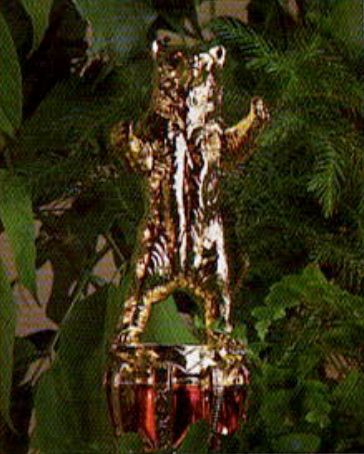
I accepted my award with pride-it’s the only trophy I’ve chosen to display in public. It has a shellacked wooden base and a figure of a grizzly bear standing on its hind legs, looking fearsome. That bear has, I imagine, just spotted a skinny hu- man being in yellow-and-black-tights run- ning through its domain.
For a week after Le Grizz, I hob- bled down the hallways of the building in downtown Spokane where I work, hoping someone would question the reason behind
my limp. (“Oh, that? Nothing serious, re- ally. Just tired legs from a 50-mile run. That’s right, 50.”) Gradually, my muscles began to rebuild. In a strange way, though, I relished the residual pain-evidence of my journey through the world beyond the marathon.
And after that?
The Le Grizz entry form says this about the postrace period. “You might feel burned out for four days as a result of en- ergy depletion. Then comes some eupho-
ria.”
Spady had put it differently when we chatted right after the run. “I’ve got some real bad news for you,” he said, grin- ning somewhere beneath his Fu Manchu. “In about three days you’re going to think you had fun out there today.”
He was wrong. It took almost a week.